


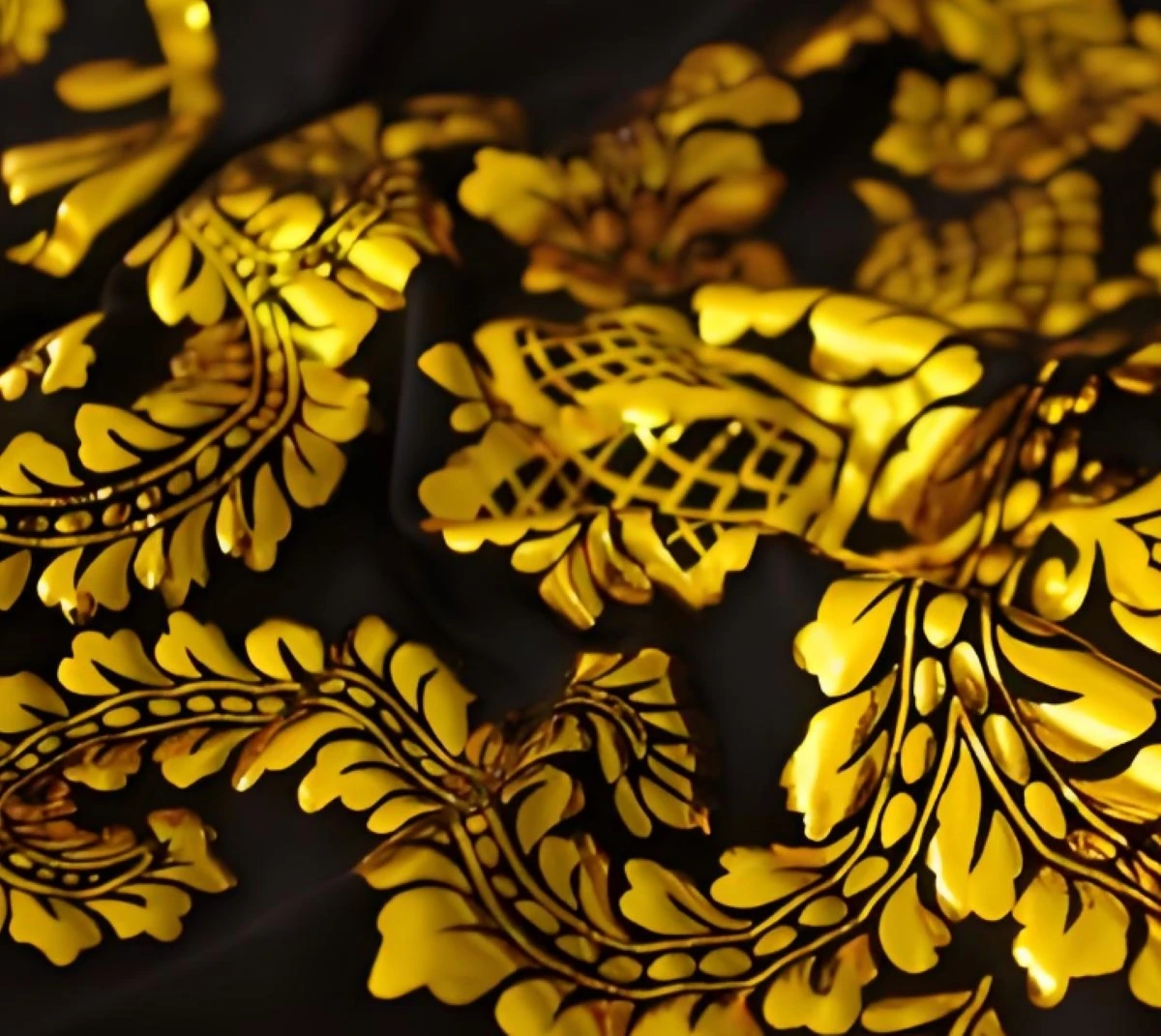
When fingertips sink into soft velvet while the eyes are captivated by shimmering gilded patterns dancing on its surface-this interplay of "hard and soft," "textured and luminous" defines the unique charm of velvet flock gilding.
As an "aristocratic craft" in textile decoration, velvet flock gilding must tame fluffy fibers while ensuring lasting metallic brilliance, with each step revealing a delicate balance of technology and artistry.
Today, we unravel this "gilded magic on velvet."
I. Three Core Processes: The "Differentiating Code" of Velvet Flock Gilding
1. Hot Stamping: Precise Taming Under Heat
-
Principle:
Uses 120-180°C heat and 5-15MPa pressure to fuse the metallic layer of foil onto the velvet surface, creating a durable bond.
-
Advantages:
High Gloss: Complete metal transfer yields mirror-like sharp reflections-ideal for logos, text, and crisp patterns.
Strong Adhesion: Hot-melt adhesive penetrates fiber roots, enduring 30+ dry-cleaning cycles (vs. 10 for standard cold foiling).
-
Applications:
High-end fashion: Gilded family crests on cashmere coat collars; gradient peony motifs on qipao lapels.
Home décor: Gilded window-lattice patterns on velvet curtains; gold-trimmed edges on wool rugs.
-
Notes:
Adjust pressure based on pile density-use 120°C low heat/slow press for short pile (e.g., panne velvet); opt for 150°C rapid press for long pile (e.g., faux fur) to avoid fiber scorching.

2. Cold Foiling: A Gentle Imprint at Low Temperatures
-
Principle:
Without high temperature, the hot stamping foil is adhered to the surface of the flannel with a water-based pressure-sensitive adhesive, and then the carrier is peeled off with mechanical pressure.
-
Advantages:
Protects Fiber Structure: No heat damage-ideal for acrylic velvet or coral fleece.
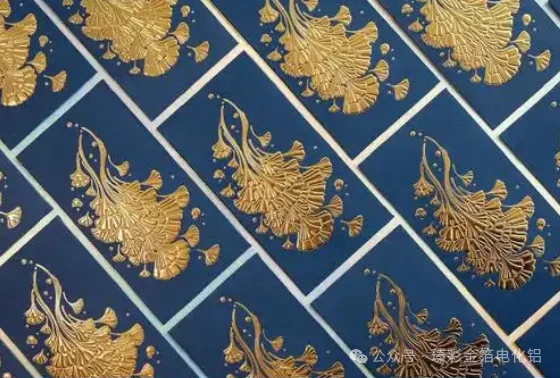
Precision Detailing: Achieves "floating gold" 3D effects by gilding between fibers.
-
Applications:
Children's products: Gilded eyes on plush toys (safe for heat-sensitive fabrics); baby blanket patterns.
Luxury accessories: Gilded title pages on velvet journals; gold-fleck accents on velour hairpieces.
-
Weakness Overcome:
When combined with "nano-grade wear-resistant glue" (solid content ≥ 45%), the number of wear times can be increased to 20 times, which is close to 70% of the hot pressing process.
3. Digital hot stamping: data-driven personalized customization
- Principle:
Prints UV-curable hot-melt adhesive patterns, then transfers foil selectively via heat press (0.1mm precision).
- Advantages:
Complex Designs Effortless: Supports gradients, translucent foils, and micro-embossing (e.g., shooting-star trails on galaxy velvet).
- Applications:
Small-Batch Ready: No plates needed; samples go from design to finish in 30 minutes.
Culture/design:The Palace Museum co-branded velvet notebook uses digital hot stamping to achieve the dynamic effect of "the gloss of gold foil changes with the angle of the velvet."

II. Three strategies for wear resistance and scratch resistance: let gilding stand the test of time
1. Pre-Treatment: Creating "Golden Anchor Points"
-
Villi directional treat:
Corona discharge lifts fibers to a 15° angle, increasing foil contact area by 30%.
-
Primer reinforcement layer:
5-10μm water-based PU primer raises surface roughness from Ra0.8 to Ra1.2 for stronger grip.
8 untreated vs. Pre-treated velvet withstands 25 rubs (GB/T 21196)
2. Process Optimization: The "Golden Ratio" of Pressure Curves
-
Hot Stamping:
Three-stage pressure-5MPa for 3s (fixes pile) → 12MPa for 5s (full transfer) → 3MPa slow release (prevents edge lift).
-
Cold Foiling:
Ultrasonic vibration (20kHz) drives adhesive 0.3mm into pile roots.


3.Post-processing: Protective armor for gold foil
-
Nano-coating technology:
After hot stamping, a 0.1mm thick TPU transparent film is applied, which increases the wear resistance by 40% while retaining more than 85% of the metallic luster;
-
Ultraviolet curing (UV):
Adding photoinitiator to the cold-stamping glue and irradiating it with a 365nm ultraviolet lamp for 30 seconds increases the hardness of the glue layer from Shaw A50 to A70, which can resist scratching by nails.
III. hot stamping foil for flannel: the "invisible key" suitable for the material
1. Fluff-friendly hot stamping foils
-
Short Pile (<0.5mm):
Formula: EVA hot-melt adhesive + 3% nano-silica for Reduce surface tension and achieve "self-filling of villi gaps"
For: panne velvet, gold velvet, plain velvet.
Example: Zhencai TB Series-98% transfer rate.
-
Long Pile (0.5-2mm):
Design: 20μm thick adhesive + 10% elastomer resin forAdapt to the stretching deformation of the fluff when it swings
For: Faux fur, coral fleece, PV velvet.


2. Performance-Enhanced Foils
-
Weather-Resistant(outdoor scenes):
UV-blocking layer (5μm) passes 1000hr QUV aging test.
Use: Brand logos on awnings; gilded camping gear.
-
Eco-Safe (Baby Grade):
Water-based acrylic + biodegradable PET carrier; OEKO-TEX 100 certified (formaldehyde <0.1ppm).
3. Effect-Innovation Foils
-
Matte Gold:
Sandblasted surface (30-50GU gloss) for "quiet luxury"-ideal for Neo-Chinese velvet furniture.
-
Holographic:
Micro-prismatic etching creates color-shifting rainbows-popular in streetwear.

IV.From Craft to Culture: Velvet Gilding's "Boundary-Breaking" Impact
As ZARA cold-foils fractured letters onto corduroy jackets, and the Palace Museum digitally gilds velvet "scroll notebooks," this niche craft is evolving:
- Tactile Marketing: Consumers crave "texture + metallic coolness" beyond visual impact.
- Sustainability: Eco-foils + digital tech democratize luxury-level craftsmanship.
- Cultural Revival: Traditional motifs (lotus scrolls, cloud-thunder patterns) reborn in hot stamping become "soft ambassadors" of heritage.
Next time you touch gilded velvet, notice those golden details nestled in its pile-they're not mere decoration, but crystallizations of material science and design. In an era obsessed with "ultimate touch," velvet flock gilding is redefining luxury-with the warmth of a marriage of strength and softness.


